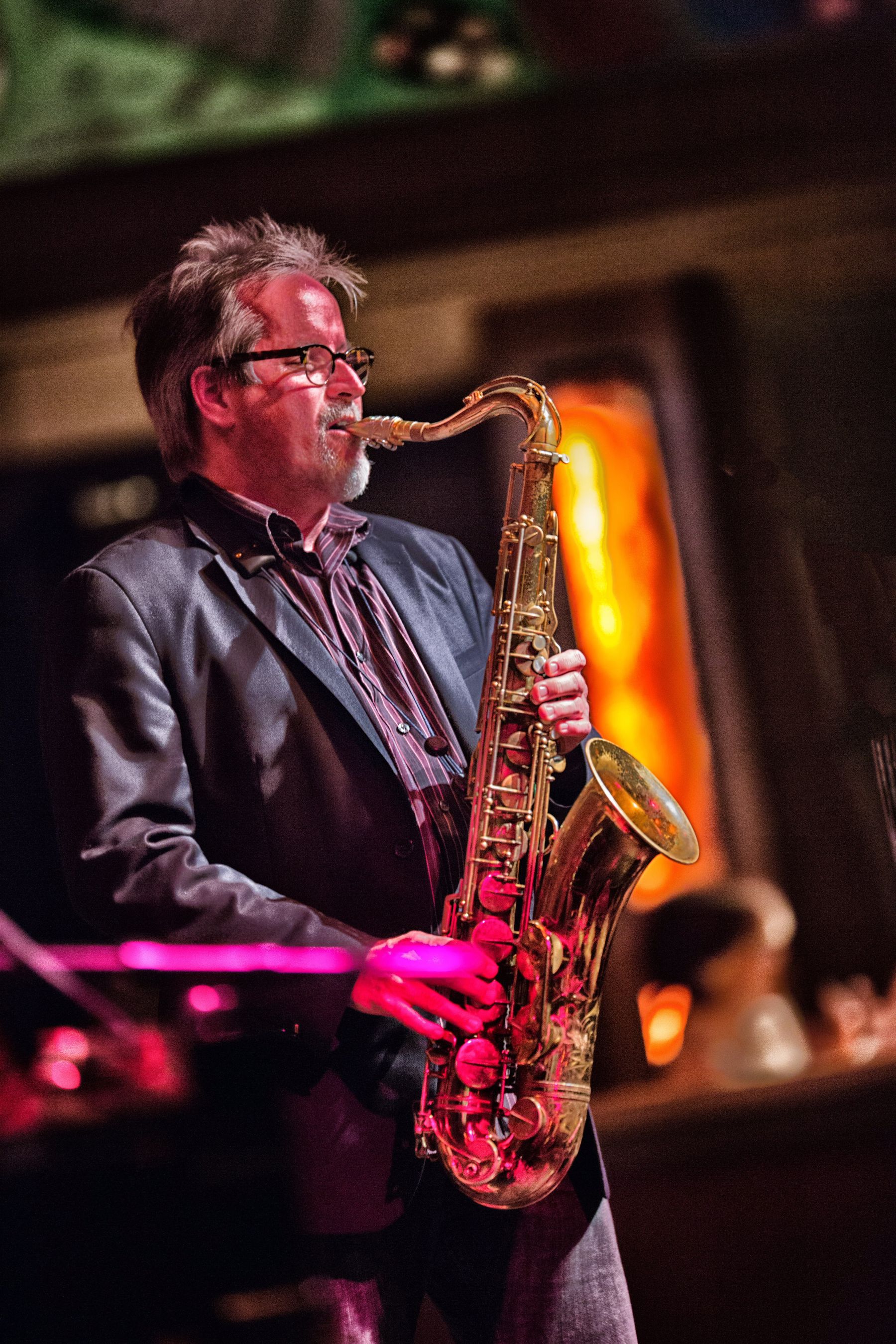
IN CONCERT : In and out jazz in L.A. - Versatile tenor saxist Chuck Manning makes his Santa Barbara debut
By Josef Woodard, NEWS-PRESS CORRESPONDENT
March 21, 2008 2:09 PM
Chuck Manning
When: 8 p.m. Thursday
Where: Muddy Waters Café, 508 E. Haley St.
Cost: $8
Information: 966-9328,
www.myspace.com/muddycafesb
Here in Santa Barbara, we've caught wind of the Los Angeles-based tenor saxist Chuck Manning at odd intervals. A few years back, his acclaimed and presently defunct band, the Los Angeles Jazz Quartet, put on a heady fine show at the Goleta Community Center, sponsored by the Santa Barbara Jazz Society. Manning has also played in town with Theo Saunders, the impressive NYC-born pianist-bandleader who spent a few years in Santa Barbara before settling in L.A.
Just last month, Manning held down the challenging sax chair in a MultiCultural Center concert featuring Bobby Bradford's Mo'Tet. In that gig, Manning was able to showcase his distinctive skill in working both the free and structured corners of the jazz ring, moving seamlessly between avant-garde ideas and swing- and bebop-inclined playing.
It will be a different story, and different song list, next Thursday at Muddy Waters, when Manning makes his official Santa Barbara debut under his own name. As part of the "Experimental Music Night" series led by Colter Frazier and Rob Wallace (who will open the show), Manning and company are coming off of a European tour and the release of his first solo CD, "Notes from the Real," on the Swiss TCB-Montreux Jazz label.
In a recent interview, Manning explained that "when I recorded this album, I was in a personal transition and I needed to say something to myself. It was a gift to me. I wanted to play old show tunes such as Frank Loesser's 'I Believe In You' and Irving Berlin's 'Change Partners' because they are not part of the typical jazz quartet repertoire and so they sound fresh but familiar.
"If I, like so many musicians I know, worked out complicated arrangements and have the musicians read music on the band stand, we would miss out on the magic that happens when the eyes are closed and the inner voices are allowed to sing. This approach is what creates a powerful, personal sound."
One can hear the imprint of John Coltrane's influence, and from various stages of the late, great tenor player's work, in Manning's approach -- as with many other tenor players.
"The Coltrane influence is, like the Miles Davis influence, connected to the idea of musical and personal evolution," Manning says. "John Coltrane transformed himself in such a linear way that mirrored the music's history. This is not true anymore. Now, the most important thing is to be true to one's self."
Manning's particular sense of musical self is notable, in part, for his openness to multiple stylistic approaches. In the vernacular, Manning happily moves between "outside" -- i.e. freer and more experimental -- and "inside," traditional playing. The latter persona, working smoothly with chord changes and an easy-going sense of swing, is more on display on his new CD.
Born in Washington State, he began to affirm his musical attitudes when he went to college at the well-known jazz mecca of North Texas State (now called the University of North Texas) in the late '70s. He later moved to Toronto and finally to Los Angeles in the late '80s. But from his Texas days, Manning remembers "at that time, there was still the idea that jazz improvisation had a linear evolution from the early jazz pioneers in the first recordings to the avant-garde and Miles Davis' jazz-rock abstractions of the '70s.
"I studied the full historic lineage of this music and I was receptive to listening to these recordings, trying to hear them without stylistic prejudice. I realized that the musicians of the early 20th century, like Armstrong, were thinking in an 'outside' way and just as radical as (noted avant-garde saxist) Albert Ayler much later.
"What matters to me still is not the style, context, instrumentation of the performance, but the soul, emotion and thought behind it, and I apply the same standard to all types of music as well."
One influential figure has been Bradford, whom he studied with upon moving to Pasadena in 1980, and in whose band Manning has played a key role. The saxist comments "Bobby Bradford music has always had a big impact on my own philosophy of improvisation. Really, the bottom line is, if you hear it, you should play it. And if you are trying to play a preconceived idea such as one based on a harmonic 'theory,' then that will get in the way of the creative process. My philosophy has been that I needed to really understand jazz like a first language so that I am speaking without thinking."
Clearly, things are coming together for Manning at the moment. It can be a challenge for a serious jazz artist to base operations in Los Angeles, as opposed to the jazz base of New York, but he's doing the right things and deserves whatever attention is coming his way.
"I have never been more in touch with my own voice as I am now," Manning says. "I just got back from a tour in Europe to promote my CD; that was very exciting and I got such a great response from the audiences there. I will be going back to do some festivals in late summer and I plan to record another CD this year. This is the most musically healthy period in my life."